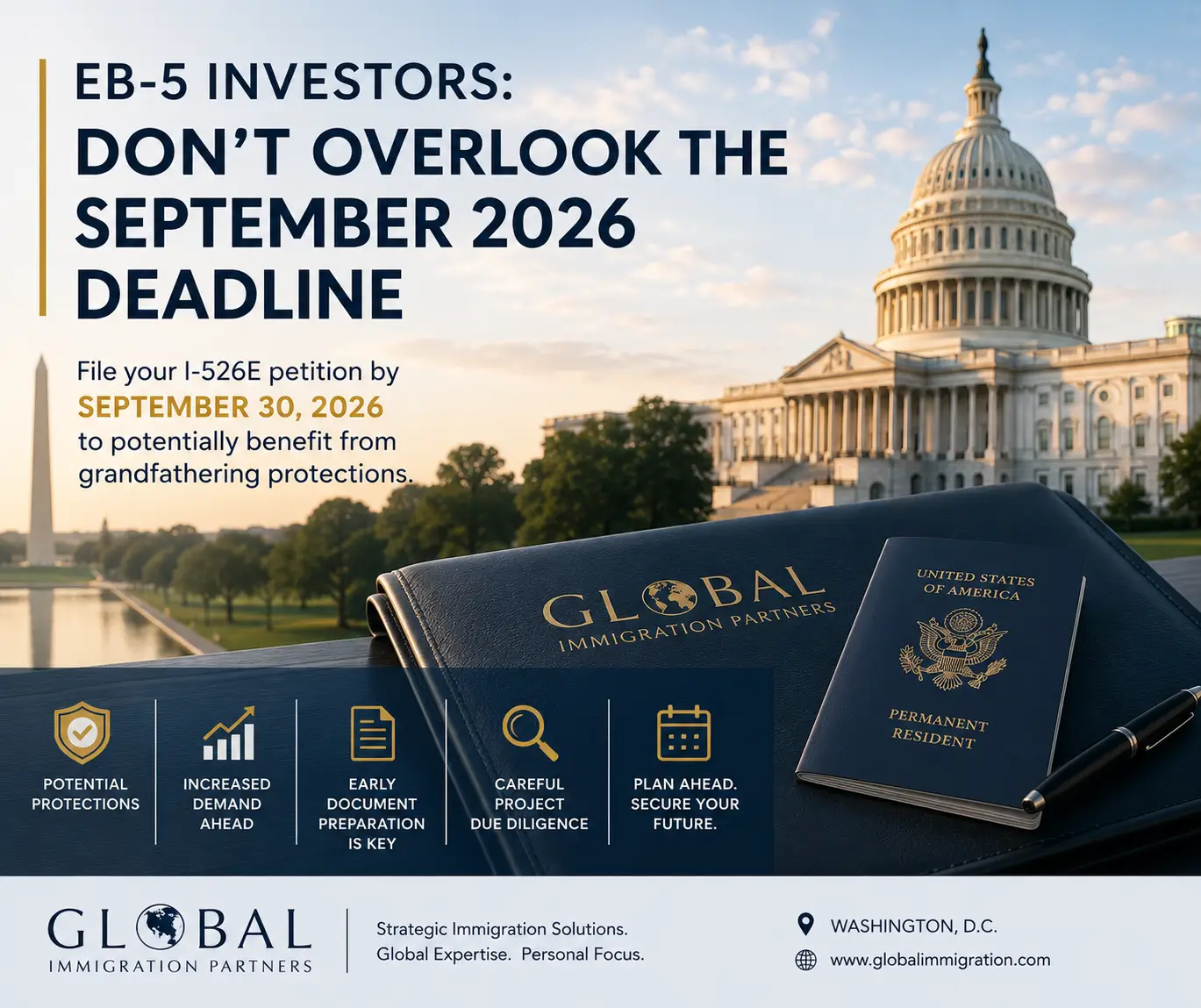
Many foreign investors choosing the EB-5 Immigrant Investor Program are ultimately aiming for U.S. citizenship. While the EB-5 program leads to a green card, the path from investment to citizenship involves several stages, each with its own timeline and requirements.
If you’re wondering how long after receiving your conditional green card you can apply, what the physical presence rules are, and how time outside the U.S. affects your citizenship eligibility, this guide explains everything clearly.
How U.S. Citizenship Works for EB-5 Investors
The EB-5 program does not provide citizenship directly. Instead, it provides a two-step permanent residency process, after which you may qualify for naturalization (becoming a U.S. citizen).
The general immigration sequence is:
- Conditional Green Card (valid for 2 years)
- Removal of Conditions – Form I-829
- Permanent Green Card
- Eligibility for Naturalization – Form N-400
1. When Can You Apply for U.S. Citizenship After Receiving Your EB-5 Green Card?
You can apply for U.S. citizenship 5 years after becoming a lawful permanent resident.
The key point:
The 5-year countdown starts the day your conditional green card is issued, not the day the conditions are removed.
So the timeline usually looks like this:
- Year 0 — Receive 2-year conditional green card
- Year 2 — File Form I-829 to remove conditions
- Year 5 — Eligible to apply for naturalization (Form N-400), assuming all requirements are met
Even if your I-829 takes a long time to process, your eligibility for citizenship is still based on the original green card start date.
Early filing rule
USCIS allows filing the naturalization application up to 90 days before the 5-year mark.
This can make a meaningful difference for EB-5 investors eager to complete the process.
2. Physical Presence Requirements for EB-5 Investors Seeking Citizenship
To qualify for naturalization, EB-5 investors must satisfy the same residence rules as other permanent residents.
The two main requirements:
Continuous Residence: 5 years in the U.S. as a permanent resident
A “continuous residence” means you have maintained your primary home in the U.S. throughout the 5-year period.
Physical Presence: At least 30 months (2.5 years) physically spent in the U.S.
These 30 months do not need to be consecutive.
3. Does Travel Outside the U.S. Affect Citizenship Eligibility?
Yes — extended absences can disrupt your continuous residence and delay your eligibility for citizenship.
Here’s how:
Trips under 6 months:
Generally no impact on naturalization eligibility.
Trips of 6–12 months:
Likely to break continuous residence unless you prove you did not intend to abandon residency.
Supporting evidence might include:
- Maintaining a U.S. home
- Filing U.S. taxes
- Family remaining in the U.S.
- Continuing U.S. business or employment ties
Trips of 12 months or more:
Almost always break continuous residence, resetting the 5-year clock.
To preserve residency during long absences, some investors use:
Reentry Permits (Form I-131)
These allow reentry after absences of up to 2 years, but do not prevent the break in continuous residence for citizenship purposes.
4. Do Delays in I-829 Processing Affect Citizenship Eligibility?
A common EB-5 concern is whether slow processing of the I-829 petition delays U.S. citizenship eligibility.
Good news:
Even if your I-829 takes years to be approved, you can still apply for citizenship at the 5-year mark (minus the 90-day early filing window), as long as:
- You filed the I-829 on time
- You remain in valid conditional permanent resident status
USCIS guidance confirms this.
5. Summary: How EB-5 Leads to U.S. Citizenship
EB-5 Citizenship Timeline Overview
| Stage | Time |
|---|---|
| Conditional Green Card Issued | Year 0 |
| I-829 Filed | Year 2 |
| Eligible for Citizenship | Year 5 (or 4 years + 9 months with early filing) |
Citizenship Requirements:
- – 5 years of continuous residence starting from conditional green card issuance
- – 30 months physically present in the U.S.
- – No long absences that break residence
- Good moral character and other standard naturalization criteria
Final Takeaway
You can become a U.S. citizen through EB-5 5 years after receiving your conditional green card, regardless of how long I-829 processing takes — as long as you maintain residence and meet the physical presence requirements.
For EB-5 investors who plan carefully, U.S. citizenship is a predictable and achievable outcome.