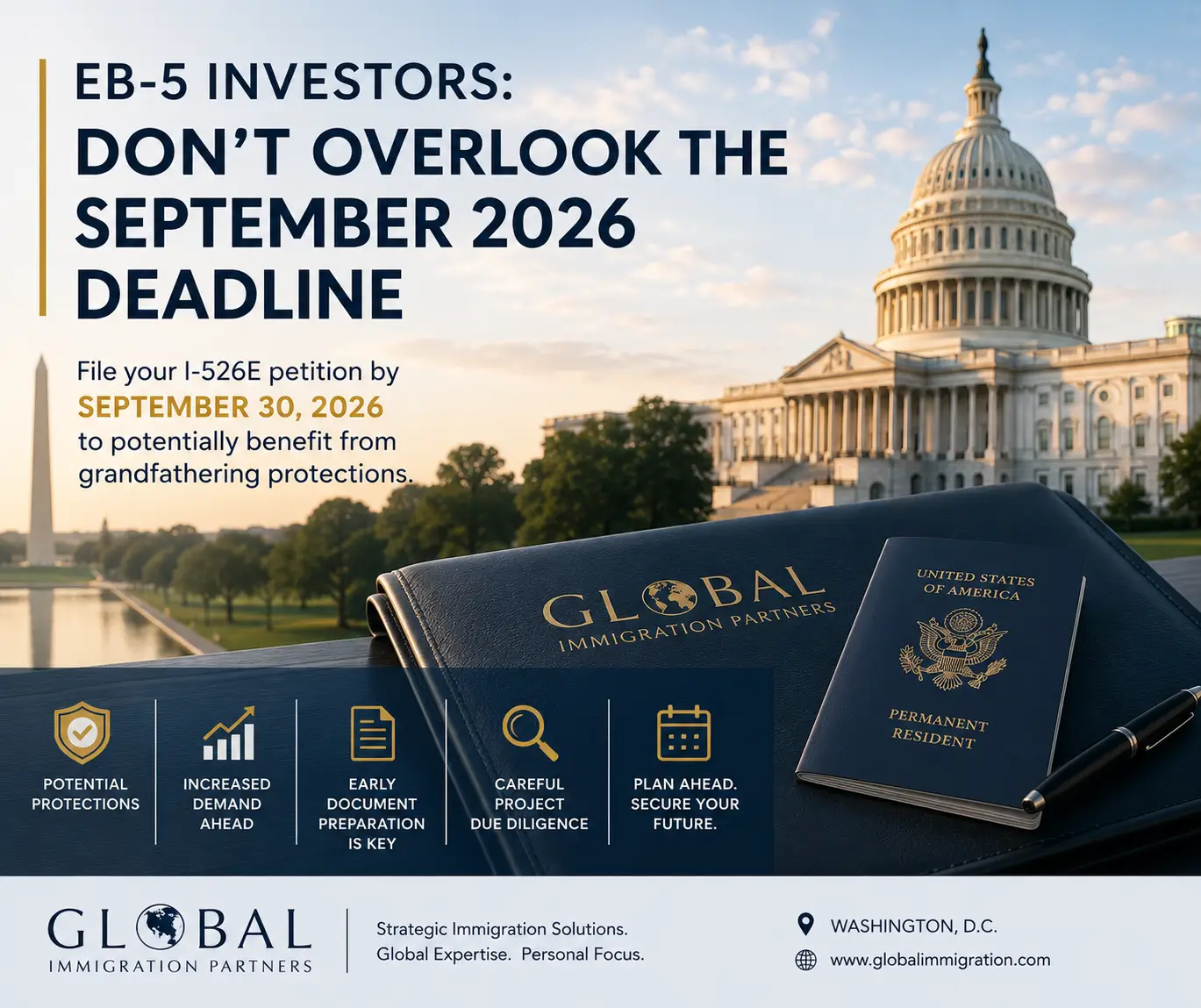
U.S. business immigration encompasses a broad range of visa categories, work authorisation pathways, and employment-based green card options designed for foreign nationals pursuing professional or entrepreneurial objectives in the United States. This guide provides a structured overview of the principal U.S. business immigration categories, current eligibility requirements, and key procedural considerations. Global Immigration Partners is available to advise on the most appropriate strategy for your situation and to provide end-to-end legal support throughout the immigration process.
Types of Business Visas for the U.S.: Current Requirements (2026)
Foreign nationals who want to establish or run a business in the U.S. must obtain the right visa. The main business visas are listed below, with their current 2026 requirements.
E-2 Treaty Investor Visa
The E-2 lets foreign nationals from treaty countries invest in and manage a business in the U.S. It is popular with entrepreneurs and small business owners who want to run their own business in the United States.
- Substantial investment in a real, operating business (no minimum set by law, but generally $100,000 or more in practice)
- Investor must develop and direct the business actively
- Create jobs for U.S. workers or show the investment is more than marginal
- Applicant must be a national of a treaty country that has an E-2 agreement with the U.S.
- Valid for 2 years initially, renewable in 2-year increments with no set limit
- Spouse and family members can receive E-2 dependent status; spouses may apply for work authorization
L-1 Visa (Intracompany Transfer)
The L-1 lets multinational managers, executives, and specialized employees transfer from a foreign company to a U.S. office. It is the main business immigration tool for companies expanding into the U.S. market.
- L-1A (executives/managers): Initial 3 years; up to 7 years total
- L-1B (specialized knowledge): Initial 3 years; up to 5 years total
- Employee must have worked for the foreign company for at least 1 continuous year within the past 3 years
- New office L-1: Company is establishing a new U.S. entity. Initial approval is 1 year only, with stricter review at extension
- No annual cap and available year-round without lottery
- Visa holders have dual intent and can pursue a green card while on L-1 status
H-1B Specialty Occupation Visa
The H-1B lets U.S. employers hire foreign workers in specialty occupations requiring at least a bachelor’s degree. It is the most commonly used employment based work permit for skilled workers and professionals holding advanced degrees.
- Requires a U.S. job offer from a sponsoring employer in a specialty occupation
- Applicant must hold a bachelor’s education or higher (or equivalent) in a directly related field
- Annual cap: 65,000 regular cap + 20,000 for U.S. master’s degree holders (advanced degree exemption)
- FY 2026 registration: Approximately 339,000 unique registrants, a 20.5% decline from FY 2025, per USCIS data
- FY 2027 new rule (effective Feb. 27, 2026): H-1B skills-weighted lottery, higher-wage positions get more chances in the draw, per USCIS H-1B Cap Season
- Social media accounts now reviewed for H-1B applicants as part of enhanced vetting (December 2025 change)
- USCIS site visits by FDNS agents have increased; employers should audit their visa practices and compliance records
Other Key Business and Employment-Based Visas
EB-5 Immigrant Investor
The EB-5 program provides a direct pathway to U.S. permanent residence for foreign investors who commit a qualifying capital investment, $800,000 in a Targeted Employment Area or $1,050,000 in a non-TEA location, and demonstrate that the investment will create at least ten full-time positions for U.S. workers. The EB-5 category is the only employment-based immigrant visa that does not require employer sponsorship or a job offer.
EB-1C Multinational Executive or Manager
The EB-1C category offers an employment-based green card for qualifying multinational executives and managers who have been employed abroad by a related entity and are transferring to a U.S. affiliate, subsidiary, or parent company. No PERM labor certification is required, making this one of the more efficient pathways to permanent residence for senior corporate professionals. Eligibility is closely tied to the L-1A nonimmigrant classification, and many EB-1C beneficiaries transition directly from L-1A status.
EB-2 National Interest Waiver (NIW)
The EB-2 NIW allows professionals holding advanced degrees, or individuals with exceptional ability in their field, to self-petition for a U.S. green card without employer sponsorship or a labor certification. To qualify, the applicant must demonstrate that their work is in the national interest of the United States, a standard that has been interpreted broadly across sectors including science, technology, healthcare, business, and academia.
O-1 Extraordinary Ability Visa
The O-1 visa is a nonimmigrant work authorisation category for individuals who have demonstrated extraordinary ability in their field, whether in science, business, education, the arts, or athletics. Unlike the H-1B, the O-1 is not subject to an annual numerical cap, making it a particularly valuable option for highly accomplished professionals who require flexibility in their U.S. work arrangements.
EB-3 Skilled Worker and Professional
The EB-3 category provides employment-based permanent residence for skilled workers, professionals holding a U.S. bachelor’s degree or its equivalent, and other workers in roles for which qualified U.S. workers are not available. In most cases, the sponsoring U.S. employer must first obtain an approved PERM labor certification from the Department of Labor before the immigrant petition may be filed.
B-1 Business Visitor Visa
The B-1 visa permits foreign nationals to enter the United States temporarily for legitimate business activities, including attending meetings, conferences, negotiations, or training, without engaging in productive employment or receiving compensation from a U.S. source.
Visa Comparison at a Glance
| Visa | For | Key Requirement | Duration | Green Card Path |
| E-2 | Treaty investors | $800K+ substantial investment | 2 yrs, renewable | No green card directly |
| L-1A | Executives/Managers | 1 yr with company abroad | 3–7 yrs total | EB-1C green card path |
| L-1B | Specialized workers | 1 yr with company abroad | 3–5 yrs total | Must change status |
| H-1B | Specialty occupation | Bachelor’s + employer sponsor | 3–6 yrs | EB-2/EB-3 sponsorship |
| EB-5 | Investors | $800K (TEA) / $1.05M (non-TEA) | Conditional 2-yr GC | Direct green card |
| EB-1C | Intl. managers | L-1A + qualifying role | Permanent | Direct green card |
| O-1 | Extraordinary ability | Evidence of distinction | Up to 3 yrs, renewable | No direct GC path |
Industries Attracting Foreign Nationals and Talent in 2026
Technology
The technology sector remains the largest driver of business immigration. Skilled workers and professionals in software, AI, cybersecurity, and professional business services are sponsored by U.S. employers through H-1B, L-1, and O-1 business visas. Despite a 20.5% drop in H-1B registrations in FY 2026, top talent in AI and cloud computing continues to obtain work permits, and companies are adapting to the new wage-weighted lottery by offering higher salaries to secure skilled workers.
Finance
Wall Street and U.S. financial hubs continue to attract investors, executives, and finance professionals from around the world. Foreign banks and investment firms establish U.S. company entities and use L-1 intracompany transfers and employment based green cards to staff their operations with top talent.
Healthcare
The U.S. healthcare system attracts doctors, nurses, and researchers through J-1 and H-1B visas. Professionals holding advanced degrees in medicine and research often qualify for EB-2 NIW green cards, allowing them to self-petition without an employer sponsor if their work serves the national interest.
Manufacturing, Construction, and Seasonal Work
The H-2B seasonal worker program is a key source of non immigrants for temporary labor in business sectors like construction, hospitality, and landscaping. In FY 2026, USCIS authorized an additional 64,716 supplemental H-2B visas beyond the regular 66,000 annual cap, reflecting the continued labor demand from U.S. employers.
Business Immigration Process Steps: How It Works in 2026
Identify the Right Visa Category
Are you an investor, a transferred employee, or a skilled professional being sponsored by a U.S. employer? Each category has different immigration requirements. An immigration attorney can help you pick the right path.
Check Eligibility and Gather Evidence
Confirm whether you are qualify for visa through treaty country nationality (E-2), one year with the company abroad (L-1), a qualifying job offer and degree (H-1B), or a qualifying investment (EB-5). Begin collecting supporting evidence early
Employer Petition or Self-Petition Filing
For most employment-based visas, the U.S. employer files a petition with USCIS on behalf of the foreign worker. For EB-5 and EB-2 NIW, the investor or professional files directly. Filing fees and forms vary by category.
Labor Condition Application (LCA) for H-1B
Employers must file an LCA with the U.S. Department of Labor before filing an H-1B petition. The LCA confirms the employer will pay at least the prevailing wage and meet working conditions standards.
USCIS Adjudication
USCIS reviews the petition. Processing times vary: L-1 and E-2 may use consular processing (typically faster). H-1B is subject to annual lottery. Premium processing (Form I-907) is available for some categories to speed up the decision to 15 business days. Visa Stamping at U.S. Consulate (if abroad) If the applicant is outside the U.S., they attend a visa interview at a U.S. Embassy or Consulate.
Entry to the U.S. and Maintaining Status
Upon entry, the visa holder must comply with the terms of their status: working only for the sponsoring employer (H-1B), only in the approved role (L-1), or actively managing the investment business (E-2). Status violations can jeopardize future immigration benefits.
Extension, Change of Status, or Green Card Sponsorship
Many business visa holders eventually pursue permanent residency. L-1A holders can file for an EB-1C green card. H-1B holders can be sponsored for EB-2 or EB-3. E-2 holders may pursue EB-5 if eligible. An immigration attorney can plan the path from temporary to permanent status.
Impact of Government and Immigration Policies on Business Immigration in 2026
Government regulations and immigration policies will continue to shape business immigration pathways in 2026, influencing how entrepreneurs, investors, and skilled professionals access global opportunities.
H-1B Reforms: Wage-Weighted Lottery and Higher Fees
Effective February 2026, the H-1B lottery for FY 2027 will use a new wage-weighted system. This rewards employers who offer above-average salaries and is intended to bring in top talent rather than lower-cost workers. In addition, a September 2025 presidential proclamation introduced a $100,000 fee for new H-1B petitions filed for workers outside the U.S. Immigration attorneys are advising clients to plan early and evaluate which employees are most at risk under the new system.
Increased Employer Compliance Reviews and Site Visits
USCIS Fraud Detection and National Security (FDNS) officers are conducting more unannounced site visits at employers of H-1B and L-1 visa holders. Agents verify that the actual job duties and work location match the approved petition. Employers are advised to conduct internal audits of their visa compliance records and procedures. Having an immigration attorney review your immigration matters before a visit can protect your company from penalties.
Social Media Screening for Visa Applicants
As of December 2025, the U.S. State Department extended its online presence review requirement to include H-1B visa holders and H-4 dependents. Applicants must now disclose social media handles and set accounts to public during visa adjudication. This change has extended consular processing times.
Family-Based Immigration and Dependent Visa Updates
Family based immigration remains an important part of business immigration planning. Spouses and family members of L-1, H-1B, and E-2 visa holders may receive dependent status and, in some cases, work authorization. However, a 2025 USCIS ruling ended the automatic extension of work authorization for certain non immigrants. This affects permanent residents who are waiting for immigrant visas and those on employment based paths.
Business Immigration Documentation Checklist
The documents you need depend on the visa type. Below are legal document checklists for the three most common business immigration paths. Work with an immigration attorney to make sure your package is complete and meets USCIS regulations.
| E-2 Treaty Investor Visa: Required Documents | |
| ☐ | Completed DS-160 application form (consular) or I-129 petition (change of status) |
| ☐ | Valid passport from a treaty country (valid at least 6 months beyond intended stay) |
| ☐ | Proof of nationality from a qualifying treaty country |
| ☐ | Evidence of substantial investment: bank statements, wire transfer records, purchase agreements |
| ☐ | Business plan showing the business is real, active, and more than marginal |
| ☐ | Source of funds documentation — showing investment funds were lawfully obtained |
| ☐ | Proof the investor will direct and develop the business (org charts, management contracts) |
| ☐ | Evidence of U.S. job creation or economic contribution |
| ☐ | Corporate formation documents: articles of incorporation, EIN, lease agreements |
| ☐ | Photos of business premises and operations |
| L-1 Intracompany Transfer: Required Documents | |
| ☐ | Form I-129 with L supplement (filed by the U.S. employer) |
| ☐ | Evidence of qualifying relationship between U.S. and foreign employer (org charts, financial statements, stock certificates) |
| ☐ | Proof the employee worked abroad for the company for at least 1 continuous year within the last 3 years |
| ☐ | Job description showing managerial/executive role (L-1A) or specialized knowledge (L-1B) |
| ☐ | Evidence of specialized knowledge or qualifying executive duties |
| ☐ | Business plan (required for new office L-1 petitions only) |
| ☐ | Payroll records and employment verification from the foreign entity |
| ☐ | Copies of any prior U.S. visa stamps and I-94 records |
| ☐ | For new office: office lease, bank statements, evidence of U.S. incorporation |
| H-1B Specialty Occupation: Required Documents | |
| ☐ | Certified Labor Condition Application (LCA) from the U.S. Department of Labor |
| ☐ | Form I-129 with H supplement (filed by the U.S. employer) |
| ☐ | Degree certificates, transcripts, or equivalent credentials in the specialty field |
| ☐ | Professional evaluation if degree is from a foreign institution |
| ☐ | Job offer letter describing specialty occupation duties and qualifying wage |
| ☐ | Evidence the position requires at least a bachelor’s degree in a specific specialty |
| ☐ | Copies of prior H-1B approvals and pay stubs (for extensions) |
| ☐ | Public Access File (employer’s compliance record) — required for all LCA-based petitions |
| ☐ | I-907 premium processing fee ($2,805 as of June 2026) if expedited processing needed |
Common Risks and Mistakes in Business Immigration
- Picking the wrong visa category: Applying for an E-2 when you do not qualify (wrong nationality or insufficient investment) or filing for an L-1B when the role requires L-1A standards. An attorney can confirm which category you qualify for before you obtain any legal representation or file.
- Weak source of funds documentation: USCIS scrutinizes where investment money came from. Foreign nationals who cannot trace funds from a legal and clearly documented source face denials.
- Marginal business plans (E-2): The business must show it will generate more than enough income to support the investor and create economic benefit beyond such persons’s personal support. Thin business plans are a top reason for E-2 denials.
- Filing H-1B without LCA compliance: H-1B employers must maintain a Public Access File and comply with all LCA regulations. Failure to assist employers in maintaining these records can lead to Department of Labor audits and debarment from the H-1B program.
- Letting status expire: Failing to file extension or change of status petitions on time can cause unauthorized stay and bar future entry.
- Not preparing for FDNS site visits: If the job described in the petition does not match real-world duties or location, the petition can be revoked. Employers must keep compliance records current and train employees on how to handle unannounced visits.
How Global Immigration Partners Can Assist You with Business Immigration
Global Immigration Partners is a business immigration law office with immigration attorneys and legal team members across the U.S., UK, Europe, India, and beyond. We assist employers, investors, and foreign nationals with all types of business visas and immigration services.
- Investor visas: E-2, EB-5, and EB-1C green card planning
- Corporate transfers: L-1A and L-1B visas, new office petitions, program management
- Skilled workers: H-1B visa filings, lottery strategy, LCA compliance, and extensions
- Permanent residency: EB-2 NIW, EB-3, EB-1C green card sponsorship
- Employer compliance: I-9 audits, FDNS site visit preparation, Public Access File reviews
- Family based immigration: Dependent visa planning for family members of visa holders, including spouses seeking work authorization
- Law offices in Washington D.C., London, Rome, India, Vietnam, Australia, Dubai, China, Mexico, Germany, Canada, and more
Contact us for a free consultation. Our immigration attorneys are ready to speak with clients anywhere in the world.
Frequently Asked Questions
What is business immigration and who does it apply to?
Business immigration refers to the set of U.S. immigration laws and visas that allow foreign nationals to work, invest, or operate a business in the United States. It applies to entrepreneurs who want to run their own business, executives being transferred by a multinational company, skilled workers hired by U.S. employers, investors seeking permanent residency, and professionals with extraordinary ability or advanced degrees.
What business visas are available for foreign nationals in 2026?
The main business visas for foreign nationals in 2026 are: E-2 (investor/entrepreneur from treaty countries), L-1A/L-1B (intracompany transfers for executives and specialized employees), H-1B (specialty occupation work permits), O-1 (extraordinary ability), EB-5 (investor green card), EB-1C (multinational managers green card), EB-2 NIW (advanced degree/exceptional ability self-petition), and EB-3 (employment based sponsorship for skilled workers). See our full immigration services page for more detail.
How long does the business immigration process take?
Timelines vary by visa type. E-2 consular processing typically takes 2 to 6 months from petition filing to visa issuance. L-1 petitions filed at a U.S. consulate abroad often process in 3 to 6 months; premium processing is available for petitions filed with USCIS. H-1B petitions are subject to an annual lottery that opens in March, with approved visa holders able to start October 1. EB-5 can take 2 to 5 years or more depending on nationality and visa backlog. EB-1C green cards generally take 12 to 24 months.
Can my family come with me on a business visa?
Family members of most business immigration visa categories can join the primary visa holders. Spouses and unmarried children under 21 of L-1 holders receive L-2 status; spouses can apply for work authorization. H-4 dependents can accompany H-1B holders; some H-4 spouses qualify for an EAD. E-2 dependents receive E-2D status; spouses can apply for work authorization. EB-5 and EB-1C green cards include derivative permanent residents for spouses and family members.
What is the difference between a temporary business visa and an employment-based green card?
Temporary business visas (E-2, L-1, H-1B, O-1) grant non immigrants the right to work or invest in the U.S. for a limited period. They do not automatically lead to permanent residency. An employment based green card (EB-1C, EB-2, EB-3, EB-5) grants the holder and their family members lawful permanent residency in the United States. Some temporary visa holders can pursue a green card while in the U.S. on dual intent status (H-1B and L-1).
Do I need an immigration attorney for a business visa application?
There is no legal requirement to use an immigration attorney, but business visas are among the most document-intensive and legally complex applications at USCIS. Errors in business plans, source of funds documentation, or job descriptions regularly result in Requests for Evidence (RFEs) or denials. For investors with significant capital at stake, employers managing multiple employees on work visas, and professionals whose livelihood depends on visa approval, working with experienced immigration attorneys at a specialized law office is strongly advised.
HOW WE HELP CLIENTS

Global Immigration Partners PLLC, is a specialized immigration law firm.
1717 Pennsylvania Avenue NW, Washington DC, 20006, United States
Phone: +1 267-507-6078