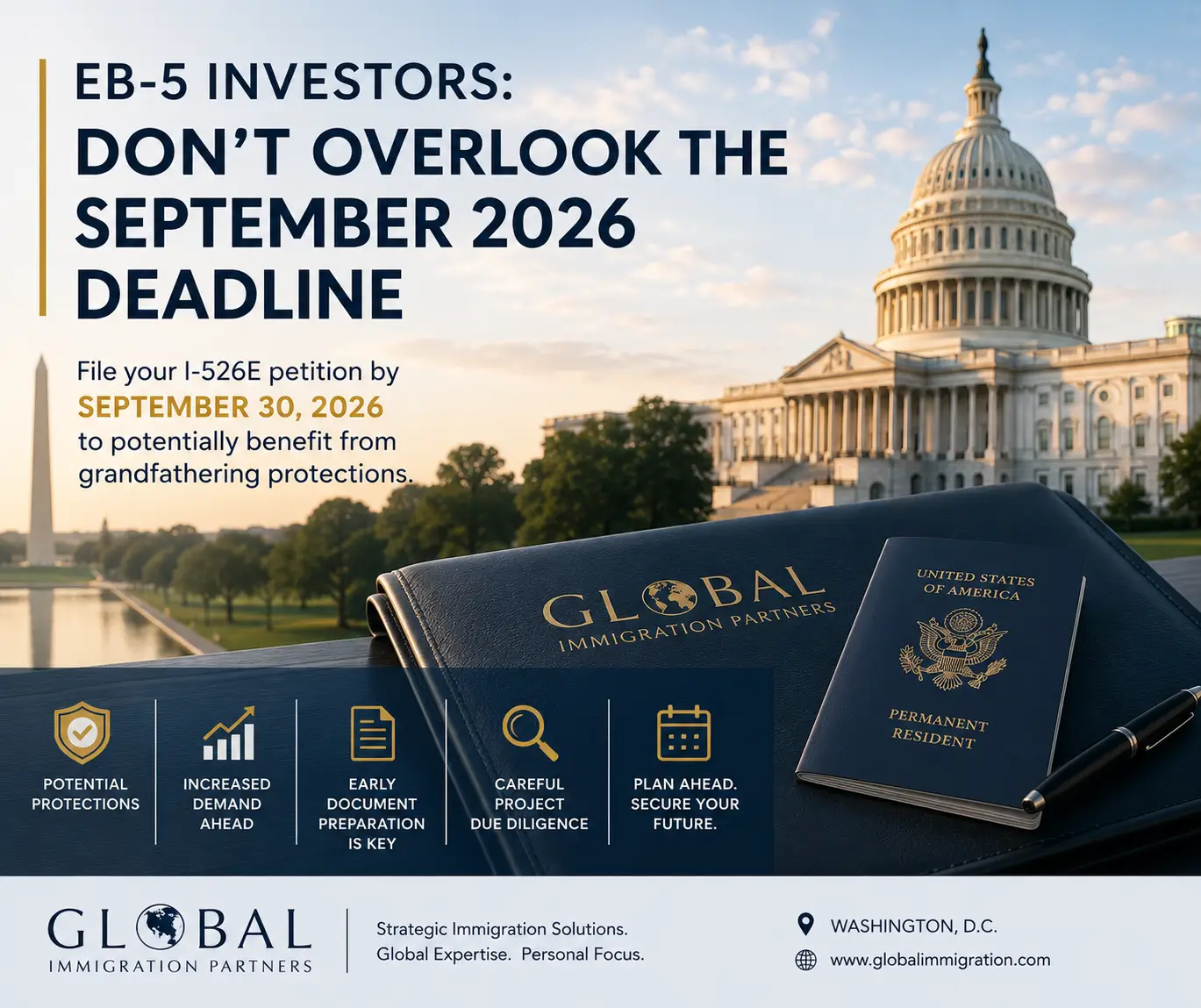
The EB-5 Immigrant Investor Program offers foreign nationals a direct pathway to U.S. lawful permanent residence through a qualifying capital investment. Established by Congress in 1990, the program serves a dual purpose: stimulating the U.S. economy and creating employment opportunities for American workers. As of 2026, the EB-5 program remains one of the most sought-after immigration routes for high-net-worth individuals and entrepreneurs worldwide.
Global Immigration Partners provides end-to-end legal guidance for EB-5 investors, from initial petition filing through the issuance of a permanent Green Card. For a comprehensive overview of the process, refer to the official USCIS EB-5 Immigrant Investor Process.
What is the EB5 Visa
The EB-5 visa is the only U.S. employment-based immigrant visa classification that grants foreign nationals permanent residency in exchange for a qualifying investment. To be eligible, an investor must place capital into a new commercial enterprise, defined as any for-profit business entity established after November 29, 1990—and demonstrate that the investment will create or preserve at least ten full-time jobs for qualifying U.S. workers.
Eligible business structures for a new commercial enterprise include corporations, limited liability companies, joint ventures, and wholly owned subsidiaries of a parent entity. Critically, the invested capital must remain at risk for the duration of the qualifying period; guaranteed returns or capital protection arrangements are incompatible with EB-5 requirements.
The minimum investment amounts, last adjusted pursuant to the EB-5 Reform and Integrity Act of 2022, are as follows:
| Investment Location | Minimum Required Investment |
|---|---|
| Targeted Employment Area (TEA) | $800,000 |
| Non-TEA (Standard) | $1,050,000 |
These thresholds are subject to periodic adjustment based on the Consumer Price Index. The next adjustment is anticipated in 2027.
Beyond new commercial enterprises, the EB-5 program also recognizes investment in an existing business as a qualifying pathway, provided the investment results in either a substantive restructuring or reorganization that gives rise to a new commercial enterprise, or a measurable expansion of the business reflected in a net worth or workforce increase of at least 40%.
Key Benefits of the EB5 Visa
- Permanent Residency: The investor, spouse, and unmarried children under 21 can obtain Green Cards.
- No Sponsorship Required: Unlike other visa categories, the EB5 does not require employer or family sponsorship.
- Pathway to U.S. Citizenship: After five years of permanent residency, investors can apply for U.S. citizenship.
- Freedom to Live and Work Anywhere in the U.S.: There are no restrictions on where EB5 investors and their families can reside.
- Education and Healthcare Benefits: Access to world-class education and healthcare systems.
Unlike most employment-based green card routes, EB-5 immigrant investors and their family members become lawful permanent residents without a job offer; the investor, spouse, and unmarried children gain permanent resident status and, after five years, can pursue citizenship.
Investment Requirements
To qualify for the EB5 Visa, an investor must:
- Invest a minimum of $800,000 in a TEA or $1,050,000 in other areas.
- Ensure the investment leads to the creation of at least 10 full-time jobs for U.S. workers.
- Engage in an eligible business venture, either directly or through a Regional Center.
Most EB-5 applicants invest through a USCIS-designated Regional Center rather than pursuing direct investment. Regional Centers are approved entities that pool capital from multiple investors into qualifying commercial projects, typically in real estate development, infrastructure, or hospitality.
A principal advantage of the Regional Center pathway is that the center itself manages day-to-day business operations, economic impact analysis, and much of the compliance documentation. This structure generally results in fewer direct management obligations for the investor. However, reduced operational involvement does not diminish the investor’s responsibility to conduct thorough due diligence prior to committing capital.
The Regional Center Program was reauthorized under the EB-5 Reform and Integrity Act of 2022, which introduced enhanced oversight, transparency requirements, and investor protections.
Step-by-Step EB-5 Process From Investment to Green Card
Step 1: Select a Project and Invest
Identify and conduct due diligence on a qualifying investment opportunity, either a direct business venture or a USCIS-approved Regional Center project. Place the required capital ($800,000 for a TEA project; $1,050,000 for a non-TEA project) into the new commercial enterprise. The funds must be placed at risk at the time of filing.
Step 2: File the Immigrant Investor Petition
Submit Form I-526E (for Regional Center investors) or Form I-526 (for standalone direct investors) with USCIS. In Regional Center cases, the center must first file Form I-956F to obtain approval for the specific project before investor petitions can be adjudicated.
Step 3: Apply for the Green Card
Once a visa number becomes available, the investor proceeds to the immigrant visa stage. Applicants residing in the United States may file Form I-485 (Application to Register Permanent Residence or Adjust Status). Applicants outside the United States complete consular processing at a U.S. embassy or consulate using Form DS-260.
Step 4: Receive Conditional Permanent Residence
Upon approval, the investor and qualifying family members receive conditional permanent resident status valid for two years.
Step 5: Remove Conditions
Within the 90-day window before the second anniversary of receiving conditional residence, the investor must file Form I-829 (Petition by Investor to Remove Conditions on Permanent Resident Status). This filing requires documented evidence that the qualifying investment was sustained and that the required ten full-time jobs were created or preserved.
Step 6: Apply for U.S. Citizenship (Optional)
After maintaining lawful permanent residence for five years, investors and their family members may be eligible to apply for U.S. naturalization under Form N-400. Specific eligibility requirements, including continuous residence and physical presence, apply.
Note: Where a visa number is immediately available and the investor is already lawfully present in the United States, it may be possible to file Form I-485 concurrently with Form I-526E, potentially reducing overall processing time. For a detailed analysis of this strategy, refer to our guide on concurrent adjustment of status for EB-5 investors.
I-526E, DS-260/I-485 and I-829 Explained
Each EB-5 stage has its own immigrant petition or application. Here is what each form does:
| Form | Purpose | When |
| I-526E / I-526 | Immigrant petition by a regional center investor (I-526E) or standalone investor (I-526) showing the qualifying investment and job creation plan | First filing |
| I-485 | Adjustment of status to permanent resident for investors already in the U.S. | After/with petition, if a visa is available |
| DS-260 | Immigrant visa application for consular processing for investors abroad | After petition approval |
| I-829 | Petition to remove conditions and confirm job creation | 90 days before the 2-year anniversary |
Document Checklist
- A valid passport for the investor and each family member.
- Evidence of the capital investment and that the investment funds are lawfully sourced (tax records, bank statements, sale or inheritance papers).
- An approved business plan or, for regional center cases, the project’s I-956F and offering documents.
- Proof the new commercial enterprise is a lawful business.
- Job creation evidence or an economic report supporting indirect jobs.
- For adjustment of status, the alien registration application (Form I-485) and supporting civil documents.
Source-of-funds proof should trace where the capital invested came from and confirm fair market value for any assets acquired; a clear paper trail for every investment fund reduces requests for evidence. Our team also reviews any promissory note, debt arrangement, or gift used to fund the investment.
The EB-5 visa requirements are the same regardless of country, but the visa interview and visa application process differ for applicants abroad. Reviewing the visa requirements and categories early, with help from experienced immigration services, keeps each foreign national and the whole application on track.
Timeline by Stage
| Stage | Typical time | Notes |
| I-526E / I-526 petition | Often 18–24 months (varies widely) | Rural set aside visas get priority processing |
| Visa availability / priority date | Current to several years | Depends on country; check the Visa Bulletin |
| I-485 or DS-260 | About 6–12 months | Concurrent filing possible if a visa is current |
| Conditional green card | 2 years | Sustainment period of at least 2 years |
| I-829 to remove conditions | Varies | File in the 90-day window |
The EB-5 process typically spans two to five or more years from initial investment to the issuance of an unconditional permanent Green Card. The exact duration depends on several variables, including USCIS adjudication times at each stage, the applicant’s country of birth, and visa number availability.
A critical factor is the applicant’s priority date, generally the date USCIS receives the Form I-526 or I-526E petition, which determines when an immigrant visa becomes available. Nationals from countries with high EB-5 demand, such as China and India, may experience extended waiting periods in the unreserved visa category due to annual per-country limits and retrogressions.
Because USCIS does not publish reliable stage-by-stage processing estimates, investors should monitor current times directly on the USCIS Processing Times page and track visa number availability through the monthly Department of State Visa Bulletin.
Costs Beyond the Investment Amount
The capital investment is only part of the budget. Investors should also plan for:
- USCIS filing fees: Form I-526E currently carries a USCIS filing fee of $11,160, plus a $1,000 EB-5 Integrity Fund fee payable at the time of filing. Subsequent forms, including Form I-485 or DS-260, and Form I-829, each carry separate fees. As USCIS fees are subject to periodic revision, investors should confirm all current charges on the USCIS Fee Schedule (Form G-1055) before filing.
- Regional center administrative fee: Most Regional Centers charge an administrative or management fee, typically ranging from $50,000 to $70,000, which is assessed separately from and in addition to the qualifying investment amount.
- Legal and source-of-funds costs: Attorney fees vary depending on case complexity. Equally significant is the cost of preparing a comprehensive source-of-funds package, the evidentiary record establishing that the invested capital was lawfully obtained. This documentation is one of the most scrutinized elements of any EB-5 petition and should be prepared with care.
- Currency and transfer costs: Investors transferring funds from outside the United States should account for exchange rate fluctuations and international wire transfer fees, which can be material for transactions at this scale.
For a detailed breakdown of total investment costs and typical investor returns, refer to our guides on how much you need to invest for EB-5 and typical EB-5 investor returns.
Common Reasons for Delay
- Incomplete or unclear source-of-funds evidence for the capital invested.
- Visa backlogs and retrogression of the priority date for high-demand countries.
- A regional center or project problem, including national security or compliance review under the Integrity Act.
- Job creation shortfalls at the I-829 stage if the new commercial enterprise underperforms.
- Requests for evidence that pause petitions filed without complete documentation.
Good planning prevents most of these. Choosing experienced regional centers with strong ongoing conduct records, filing a complete petition, and tracking the Visa Bulletin all help keep the case moving.
Why Choose Global Immigration Partners?
Global Immigration Partners provides expert legal guidance throughout the EB5 process. Our team ensures compliance with U.S. immigration laws, helps identify viable investment opportunities, and assists in documentation to enhance the chances of success. With years of experience, we are committed to making the EB5 process seamless for investors.
Conclusion
The EB5 Visa program remains an excellent opportunity for investors looking to secure U.S. residency through investment. With the guidance of Global Immigration Partners, applicants can navigate the process with confidence. Contact us today to begin your EB5 journey in 2026!
Whether you invest through one of the EB-5 regional centers or invest directly, the EB-5 program offers a clear path to a green card and U.S. permanent residence. Contact us for a consultation on your EB-5 visa, immigrant visas, and permanent residence options.
Frequently Asked Questions
What is the minimum investment for an EB-5 visa?
$800,000 for a targeted employment area (rural or high unemployment area) or $1,050,000 for other areas. These minimum investment amounts hold until the next inflation adjustment expected in 2027.
What is the difference between Form I-526 and Form I-526E?
Form I-526E is the immigrant petition for regional center investors; Form I-526 is for a standalone direct investor. Regional center projects also require the center to file Form I-956F.
How many jobs must an EB-5 investment create?
At least 10 full time jobs per investor. Direct investments need W-2 jobs, while regional centers may count indirect jobs created indirectly through approved economic models.
Can I get a green card faster with concurrent filing?
If a visa is available and you are already in the U.S., you may file Form I-485 with your I-526E, which can provide work and travel authorization in roughly 60 days while the petition is pending.
How long must the EB-5 investment stay at risk?
Under the Integrity Act, the capital must remain invested and “at risk” for at least two years from when it is made available to the job-creating entity.
Do EB-5 investors get permanent residence right away?
No. Investors first receive a two-year conditional green card, then file Form I-829 to obtain lawful permanent residence and, after five years as permanent residents, may apply for citizenship.