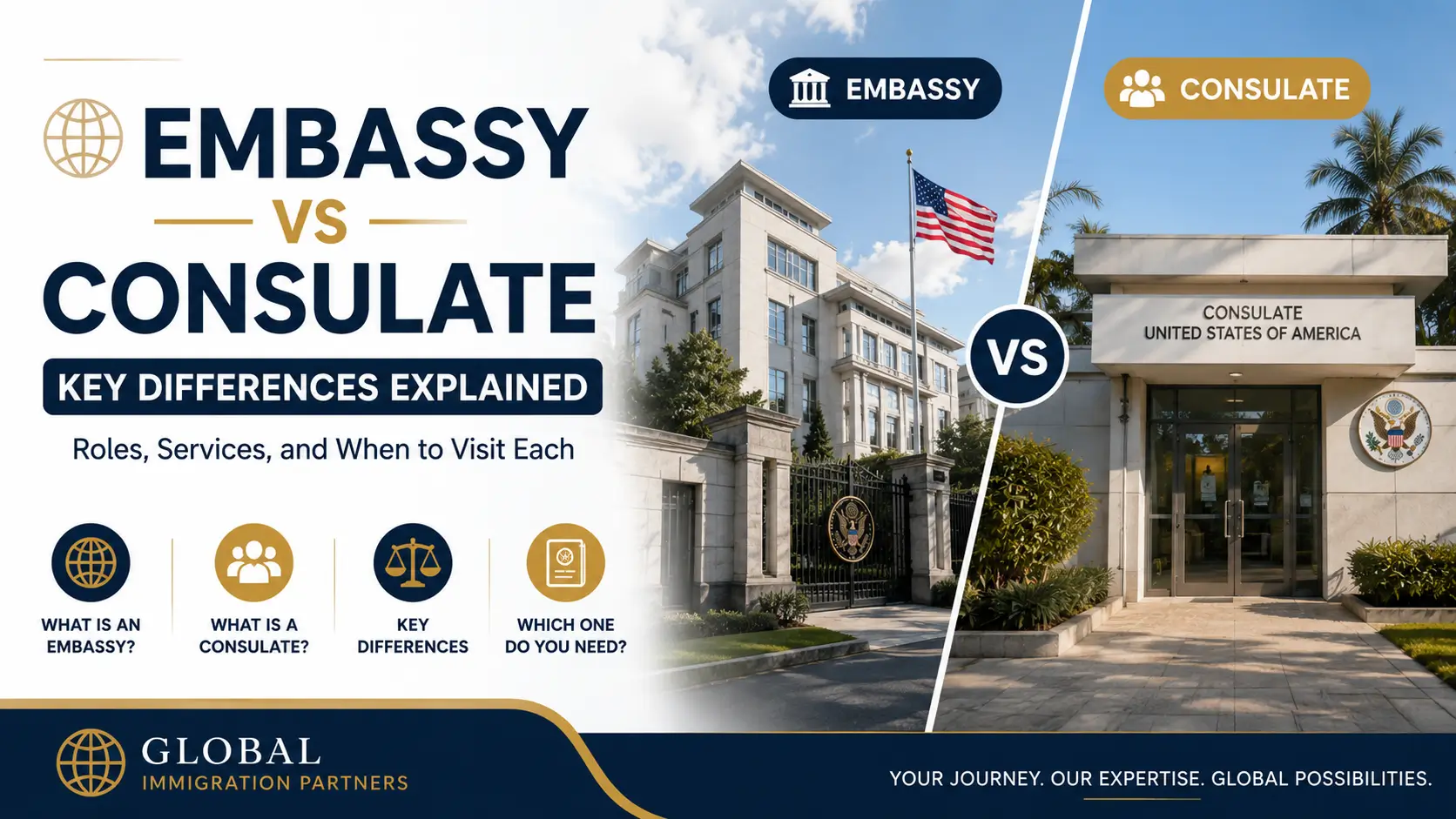
If you’re traveling, working, or applying for a visa abroad, you’ve probably heard the terms embassy and consulate. While both represent U.S. interests overseas, they serve different purposes.
Understanding the difference between an embassy and a consulate can help applicants navigate visa services, consular processing, passport services, and other immigration-related matters more effectively.
What Is an Embassy?
- Located in capital cities.
- Serve as the main diplomatic office for the U.S. in a foreign country.
- Handle high-level relations, political affairs, and major international issues.
An embassy is the primary diplomatic representation of one country in another country. It serves as the main diplomatic mission between two governments and is typically located in the capital city of the host country.
The embassy represents the sending country’s interests and manages diplomatic relations with the host nation’s government. Embassies serve as the primary channel for foreign relations, political relations, economic cooperation, security matters, and international diplomacy.
The head of an embassy is usually an Ambassador Extraordinary and Plenipotentiary, often referred to simply as an ambassador. The ambassador serves as the highest-ranking diplomatic representative of the represented country in the host nation. In addition to maintaining diplomatic relations, embassies often coordinate with international organizations, participate in discussions involving the United Nations, and work to advance national interests abroad.
Most embassies include a consular section that handles immigration processes, visa services, passport services, and assistance for citizens living overseas.
What Is a Consulate?
A consulate is a diplomatic facility that focuses primarily on providing consular services to citizens and visa applicants. Unlike embassies, consulates are commonly located in several major cities throughout the host country rather than only in the capital.
The head of a consulate is called a consul general. A larger office may be known as a consulate general, while smaller offices may simply be called a consulate.
Consulates focus on practical services that affect travelers, residents, businesses, and visitors. These offices help maintain consular relations between two countries and provide support for citizens of their own country who are living, working, studying, or traveling abroad.
Common consular services include:
- Visa services
- Passport services
- Birth registration
- Notarial services
- Assistance during natural disasters
- Emergency travel documents
- Support for detained citizens
- Assistance during medical emergencies
Consulates also play an important role in promoting trade, supporting commercial interests, strengthening cultural ties, and facilitating international exchange between the two countries.
Embassy vs. Consulate: Key Differences
Although embassies and consulates work together, their primary responsibilities differ.
| Feature | Embassy | Consulate |
|---|---|---|
| Primary Role | Main diplomatic mission, report on political, economic, and social developments. | Consular services and citizen assistance |
| Location | Usually located in the capital city | Often located in major cities |
| Leadership | Ambassador Extraordinary and Plenipotentiary | Consul General |
| Focus | Diplomatic relations, foreign relations, national interests | Visa services, passport services, citizen support |
| Government Interaction | Works directly with host country’s authorities and national government | Frequently works with local governments and regional authorities |
| Number Per Country | Typically one embassy per host nation | A country can have multiple consulates in major cities. |
| Commercial Activities | Policy and diplomatic engagement | Promoting trade and business relationships |
For example, a country may maintain one embassy located in the capital city while operating seven consulates across various regions to provide easier access to consular services.
Embassy vs Consulate for Visa Applications
In most cases, visa applicants interact with a consular section located either within an embassy or at a consulate general. Consular officers are responsible for reviewing applications, conducting interviews, verifying documentation, and determining visa eligibility.
For example, a U.S. visa applicant may submit a visa application through a U.S. Embassy or a U.S. Consulate depending on location and appointment availability. For local contact and appointment information, see the U.S. Embassy and Consulate in Dubai.
The specific location handling your case often depends on your consular district, which refers to the geographic area assigned to a particular embassy or consulate.
Whether applying for immigrant or nonimmigrant visas, applicants generally receive the same services through either location. However, some embassies handle more complex immigration cases, while certain consulates may specialize in specific visa categories.
When scheduling appointments, applicants should carefully follow instructions provided by the embassy or consulate responsible for their region.
How Embassies and Consulates Operate Under International Law
Embassies and consulates function under international law, particularly the Vienna Convention on Diplomatic Relations and the Vienna Convention on Consular Relations.
These agreements establish the legal status of diplomatic personnel and consular officers while defining the rights and responsibilities of diplomatic missions.
Under the Vienna Convention, diplomatic personnel working at embassies generally receive diplomatic immunity for official activities. Diplomatic immunity protects embassy personnel from certain aspects of local criminal jurisdiction and civil jurisdiction within the host country. Consular officers generally receive more limited protections compared to diplomatic personnel.
Although embassies and consulates enjoy certain privileges, they are still expected to respect host country’s laws and maintain cooperative relationships with host country’s authorities.
Consular Processing vs Adjustment of Status
One of the most common immigration questions involves understanding the difference between consular processing and adjustment of status. Both pathways can lead to permanent residence, but the appropriate option depends on where the applicant is physically located.
Consular Processing
Consular processing occurs when an applicant is outside the United States and applies for an immigrant visa through a U.S. embassy or consulate abroad.
The process generally involves:
- Petition approval
- National Visa Center processing
- Document submission
- Visa interview
- Immigrant visa issuance
After approval, the applicant enters the United States as a permanent resident.
Adjustment of Status
Adjustment of status allows eligible applicants already present in the United States to apply for permanent residence without leaving the country.
Applicants file the required forms with U.S. immigration authorities and attend a biometrics appointment and, when required, an interview.
Comparison Table
| Factor | Consular Processing | Adjustment of Status |
|---|---|---|
| Applicant Location | Outside the United States | Inside the United States |
| Interview Location | Embassy or consulate | USCIS office |
| Travel Requirement | Requires international travel | Generally no international travel required |
| Final Outcome | Immigrant visa issuance | Green Card approval |
| Processing Agency | Department of State | USCIS |
Understanding CEAC and NVC Status Terms
Many immigrant visa applicants track their case using the Consular Electronic Application Center (CEAC) and communications from the National Visa Center (NVC). Understanding common status updates can reduce confusion during the application process.
- At NVC: The National Visa Center has received the approved petition and is preparing the case for further processing.
- In Transit: The case has been transferred from the NVC to the designated embassy or consulate.
- Ready: The embassy or consulate has received the case and is ready to schedule or conduct the visa interview.
- Administrative Processing: Additional review is being conducted before a final decision can be made.
- Issued: The visa has been approved and printed.
- Refused: The application has been denied or requires additional documentation before final adjudication.
Applicants should regularly monitor CEAC for updates and follow any instructions provided by the responsible embassy or consulate.
Dropbox and Interview Waiver Eligibility
Certain visa applicants may qualify for interview waiver programs, often referred to as “Dropbox” processing. Eligible applicants can submit supporting documents without attending an in-person interview.
Eligibility depends on factors such as:
- Visa category
- Previous visa history
- Age
- Nationality
- Local embassy or consulate policies
Requirements can change frequently, and not all applicants qualify. Even when Dropbox eligibility exists, consular officers retain discretion to require an interview if additional review is necessary. Applicants should consult the specific embassy or consulate website handling their case for the most current eligibility requirements.
What to Prepare for Your Embassy or Consulate Appointment
Preparation is one of the most important factors in a successful visa appointment. Applicants should ensure that all required documentation is complete and organized before attending their appointment.
Common documents include passport, appointment confirmation, wisa application confirmation page, photographs meeting government specifications, supporting financial documents, employment records, educational credentials, immigration petitions or approval notices, and civil documents such as birth or marriage certificates
Applicants should also be prepared to discuss:
- Purpose of travel
- Employment plans
- Family relationships
- Immigration history
- Ties to their home country when required
Conclusion
Understanding the difference between an embassy and a consulate can make immigration processes and international travel much easier to navigate. While embassies serve as the primary diplomatic representation of one country within another, consulates focus on providing consular services, visa services, passport assistance, and support for citizens abroad.
Whether you are preparing for consular processing, monitoring a CEAC status update, applying through a Dropbox program, or attending a visa appointment, knowing which office handles your case can help streamline the process and reduce confusion.
Frequently Asked Questions
What is the difference between an embassy and a consulate?
An embassy is the main diplomatic mission of a country and is usually located in the capital city of the host country. A consulate or consulate general focuses primarily on consular services such as visa applications, passport services, and assistance for citizens.
Who leads a consulate?
The head of a consulate is known as a consul general. A consul general oversees consular operations within a specific consular district.
Do embassies and consulates provide the same services?
Many immigration-related services are available through both embassies and consulates. However, embassies serve a broader range of diplomatic functions, while consulates focus on visa services, passport services, and citizen assistance.
What is consular processing?
Consular processing is the process of applying for an immigrant visa through a U.S. embassy or consulate abroad after petition approval and National Visa Center processing.
What does “Administrative Processing” mean on CEAC?
Administrative Processing indicates that additional review is required before a final visa decision can be made. Processing times vary depending on the circumstances of the case.
Can I apply for a visa at any embassy or consulate?
Not always. Applicants are generally assigned to a specific embassy or consulate based on residence, nationality, or consular district rules.
What is Dropbox eligibility?
Dropbox eligibility allows certain applicants to submit documents without attending an in-person visa interview, subject to specific requirements and local embassy or consulate policies.
Do embassy staff have diplomatic immunity?
Diplomatic personnel assigned to embassies generally receive protections under the Vienna Convention. The scope of diplomatic immunity varies depending on the individual’s role and status under international law.